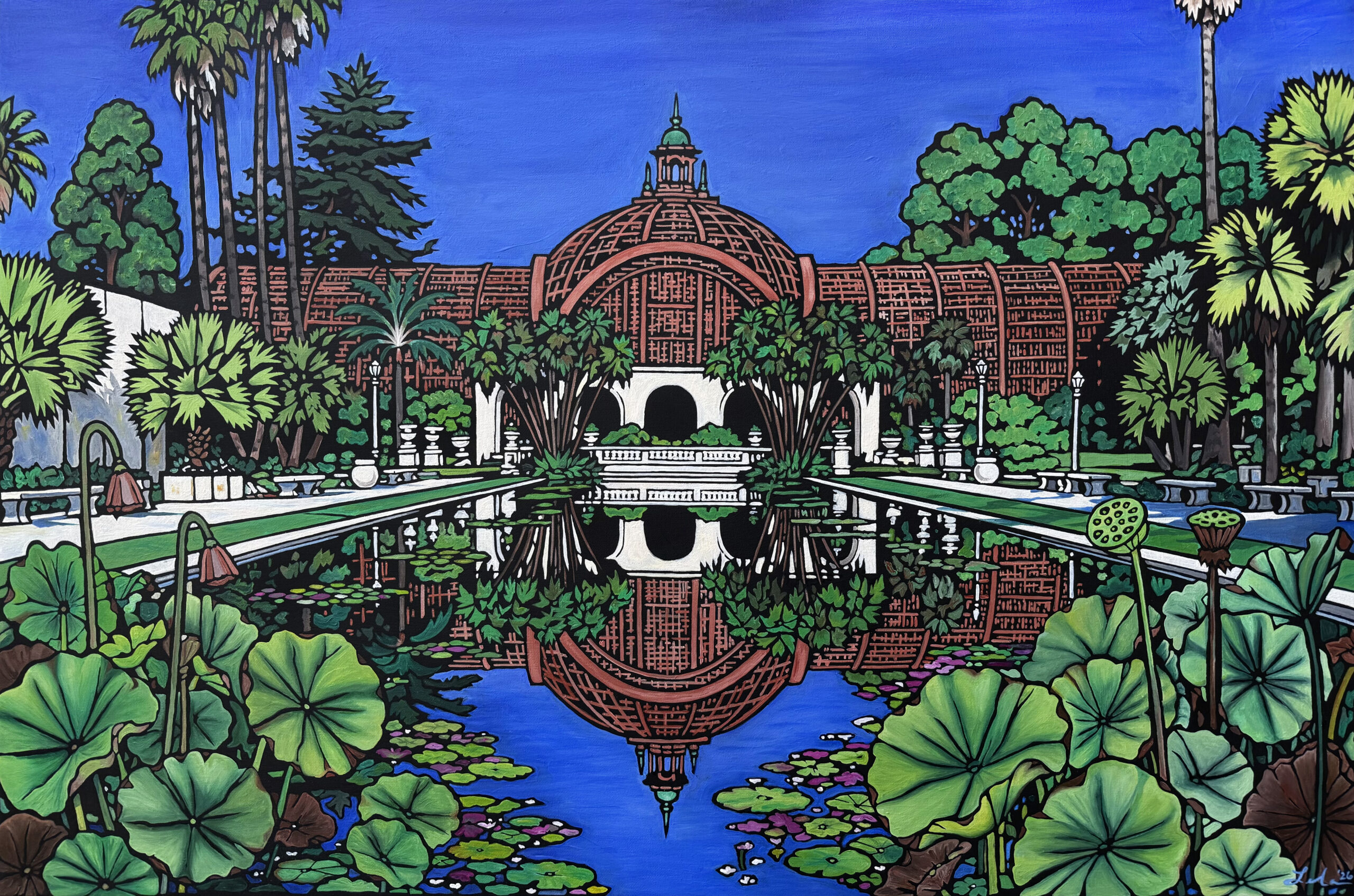
I started this painting in 2020, long before I knew it would become, in its own way, a record of a place that was about to change.
The Botanical Building and Lily Pond in Balboa Park have been part of my visual memory since childhood. When I was seven or eight years old, my mother brought me to art classes at the nearby San Diego Museum of Art, where we would sit outside on some days and draw and paint plein air in the park. There is something about this particular view that has always stayed with me. The long reflecting pool, the distinctive architecture mirrored in the water, the palms and surrounding gardens all feel deeply familiar.
The Botanical Building has its own long history. It was created for San Diego’s 1915–1916 Panama-California Exposition, the world’s fair held to celebrate the opening of the Panama Canal and to promote San Diego as the first American port of call for ships traveling north after passing westward through the canal.
The building was completed in 1914, in time for the Exposition’s opening on January 1, 1915. Envisioned by horticulturist Alfred D. Robinson and designed by Carleton Winslow under architect Bertram Goodhue, it was an extraordinary lath structure, open to light and air and filled with tropical and subtropical plants. Part of its purpose was to show visitors what could grow in San Diego’s mild climate.
More than a century later, I began painting the version of the Botanical Building that I knew. This is the pre-renovation building, with its older roofline and façade. The restoration that began in 2022 substantially changed its appearance, returning architectural elements that had disappeared during earlier renovations. So although I didn’t intend it when I began, the painting preserves a particular moment in the building’s history.
The pond itself is always changing. Over the years I have watched lilies and lotus occupy it in different combinations and densities. Rather than document the pond exactly as it appeared on a particular day, I brought together many of my favorite plants into one landscape. Giant lotus leaves rise from the foreground. Lily pads travel inward across the water. Palms, cycads, ferns and trees surround the architecture, while the building is reflected almost whole in the dark water.
It is a real place, but this is not quite a literal portrait of it. It is closer to the Balboa Park that exists in my memory and imagination, saturated, layered and slightly dreamlike.
I painted it in acrylic on black canvas, allowing the black ground to remain visible as outlines and negative space throughout the composition. For this painting I also used Matsuda acrylic paints that I bought in Tokyo during my trip to Japan. It was my first time working with them. There is something satisfying about using materials carried home from one meaningful place to paint another.
The Lily Pond has been part of Balboa Park since the Exposition itself. Originally known as Las Lagunas de las Flores, or “The Lakes of the Flowers,” the pools were conceived as aquatic gardens and have long contained water lilies and lotus.
Perhaps that is part of why I keep returning to this view. It holds both permanence and change. The building changes. The roof changes. The plantings change. Lilies disappear and return. Lotus spread across the water and recede again. Even the place I remember from childhood is no longer exactly the place that exists today.
Painting allows all of those versions to coexist.
This one is mine.